How Do You Know the Control on a Bar Graph
What are X Bar R Control Charts?
X Bar R charts are the widely used control nautical chart for variable information to examine the process stability in many industries (like Hospital patients' blood pressure level over time, customer call handle time, length of the part in production process etc.,).
Selection of appropriate control chart is very important in control charts mapping, otherwise ended up with inaccurate command limits for the data.
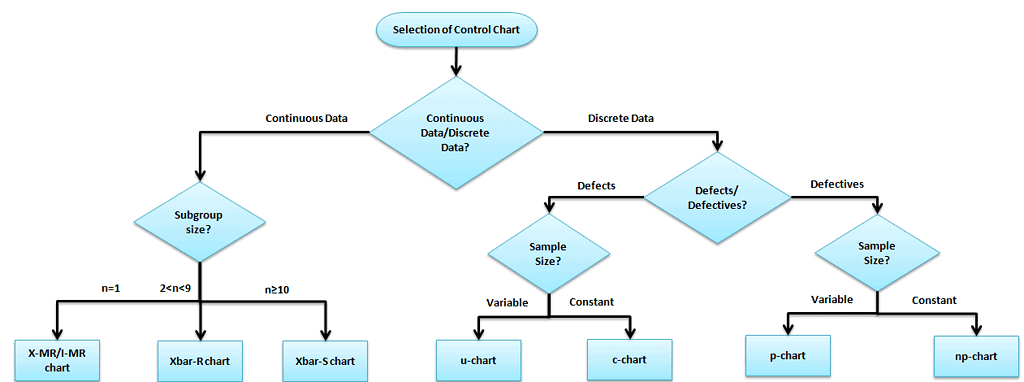
X bar R chart is used to monitor the process performance of a continuous data and the data to be collected in subgroups at a ready time periods. It is actually a two plots to monitor the procedure hateful and the process variation over the fourth dimension and is an case of statistical procedure control. These combination charts helps to understand the stability of processes and also detects the presence of special cause variation.
The cumulative sum (CUSUM) and the exponentially weighted moving boilerplate (EWMA) charts are also monitors the mean of the process, but the basic difference is unlike X bar chart they consider the previous value means at each point.
X Bar R Command Chart Definitions
X-bar chart: The mean or average change in process over time from subgroup values. The control limits on the X-Bar brings the sample's mean and center into consideration.
R-chart: The range of the process over the time from subgroups values. This monitors the spread of the procedure over the time.
Apply 10 Bar R Command Charts When:
- Even very stable process may have some modest variations, which volition cause the process instability. 10 bar R chart will help to place the process variation over the fourth dimension
- When the data is assumed to be normally distributed.
- X bar R chart is for subgroup size more one (for I-MR nautical chart the subgroup size is ane only) and generally it is used when rationally collect measurements in subgroup size is between two and 10 observations.
- The Ten Bar S Control chart are to be consider when the subgroup size is more than 10.
- When the collected data is in continuous (ie Length, Weight) etc. and captures in fourth dimension order
How to Interpret the X Bar R Control Charts
- To correctly interpret X bar R chart, always examine the R chart beginning.
- The 10 bar chart control limits are derived from the R bar (boilerplate range) values, if the values are out of control in R nautical chart that ways the 10 bar chart control limits are not accurate.
- If the points are out of command in R chart, so stop the process. Identify the special cause and address the issue. Remove those subgroups from the calculations.
- In one case the R bar chart is in control, then review X bar chart and interpret the points against the control limits.
- All the points to be translate against the control limits but non specification limits. As specification limits are provided by customer or management whereas control limits are derived from the average and range values of the subgroups.
- If any betoken out of control in X bar chat. Identify the special cause and accost the outcome.
- Procedure capability studies can be performed only afterward both X bar and R chart values are within the control limits. There is no meaning to perform process capability studies of an unstable process.
Steps to follow for X bar R nautical chart
Objective of the chart and subgroup size
- Determine the objective of the nautical chart and choose the of import variables
- Choose the appropriate subgroup size and the sampling frequency
- Collect minimum 20 to 25 sets of samples in the fourth dimension sequence
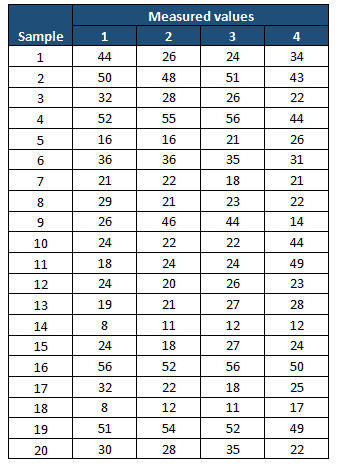
Example: In a manufacturing manufacture the plate thickness is ane of the important CTQ cistron, during Measure phase, project team performed the process capability study and identified that the process is not capable(less than 2 sigma). In Clarify phase collected 20 sets of plate thickness samples with a subgroup size of four.
Compute X bar and R values
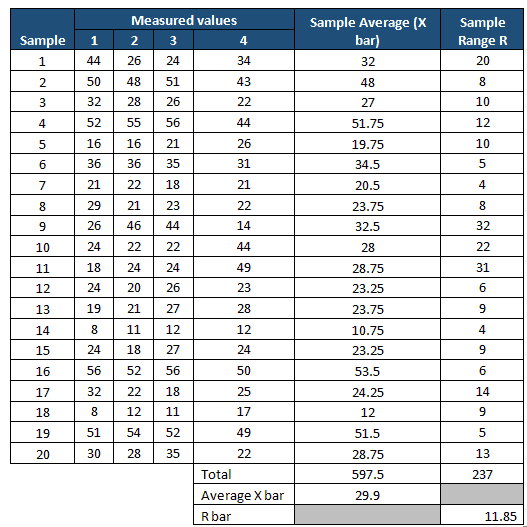
- Measure the boilerplate of each subgroup i.e 10 bar, then compute k average of all X bar value, this will be center line for X bar chart
- Compute the range of each subgroup i.e Range, and so measure thousand averages of all range values ie R bar and this will be the center line for R chart
Determine the Command Limits
- The beginning set of subgroups are to decide the process mean and standard deviation, these values are to be consider for creation of command limits for both range and mean of each subgroup
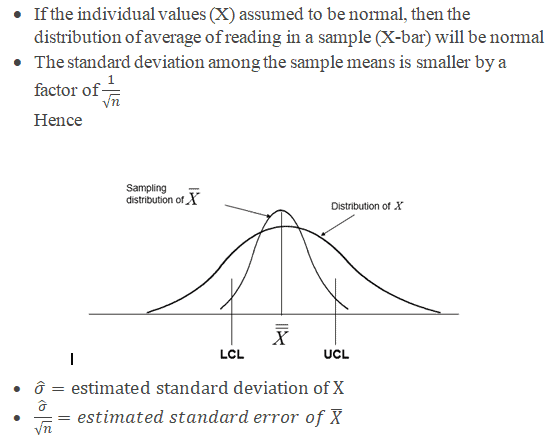
- The process to exist in command in the early phase of the production. Special causes to be identified if whatever of the points are out of control during initial phase and also the subgroup has to be removed for calculation.
- Sometimes in the initial phase it would be too good to have few points out of control on the x-bar portion. Otherwise, if all the values are within the control limits may be because of slop in the measurement system, squad won't focus on it. Identify advisable Measurement Organisation Evaluation (MSE).
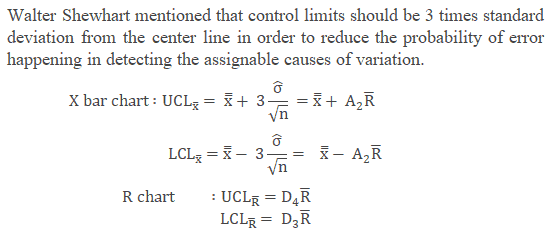
- Where
- 10 is the individual value (data)
- n is the sample size
- X bar is the average of reading in a sample
- R is the Range, in other words the difference between largest and smallest value in each sample
- R bar is the average of all the ranges.
- UCL is Upper control limit
- LCL is Lower control limit
The below control chart constants are gauge values to measure the command limits for Ten bar R chart and other command charts based on subgroup size
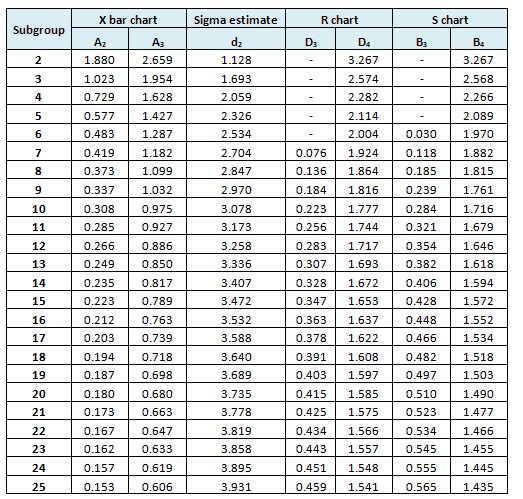
Refer common factors for diverse control charts
Example cont: In the above example due north=four
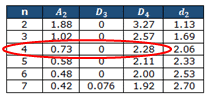
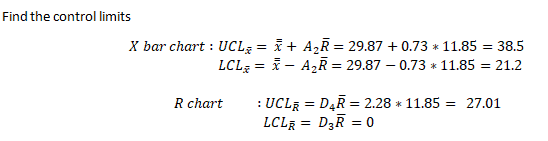
Translate X bar and R chart
- Plot both X bar and R chart and place the assignable causes
Example Cont: Use the above values and plot the X bar and Range nautical chart
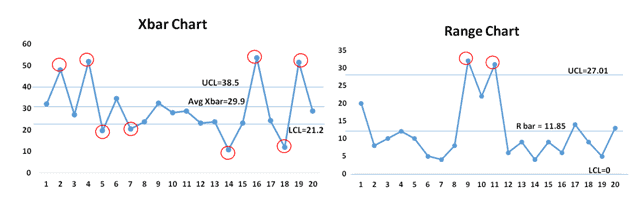
From the both X bar and R charts it is conspicuously evident that about of the values are out of control, hence the process is non stable
Monitor the process after improvement
- Once the process stabilizes and control limits are in place, monitor the process operation over the fourth dimension.
Example cont: Control Phase- One time the process is improved and matured, team identified the X bar R chart is one the command method in Control plan to monitor the process operation over the time flow
Post-obit are the measurement values in Control phase of the projection
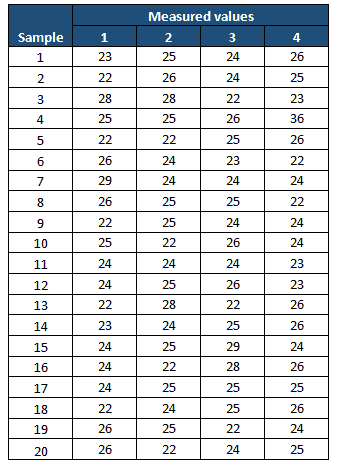
Compute Ten bar and Range
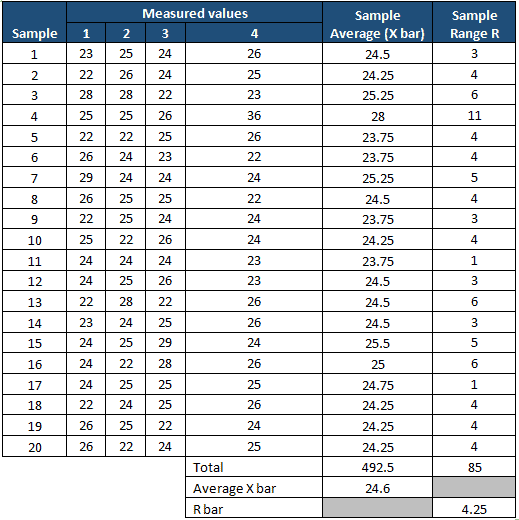
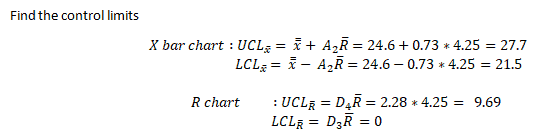
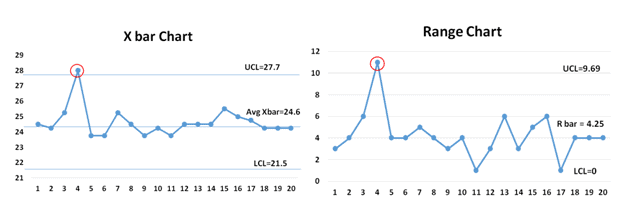
From the both Ten bar and R charts it is clearly axiomatic that the process is about stable. During initial phase one value is out of control, squad has to perform the root crusade analysis for the special cause and likewise the process is smoothing out from the information set number 16. If that continued, the chart would need new control limits from that point.
- After the procedure stabilized, still if any point going out of control limits, it indicates an assignable crusade exists in the process that needs to be addressed. This is an ongoing process to monitor the process performance.
Of import notes
- A process is "in command" that indicates means of the process is stable and it can be predictable
- A procedure is in stable that does not mean it'due south a zero defect procedure.
- Remember to NEVER put specifications on whatever kind of control chart.
- The points on the chart are comprised of averages, not individuals. Specification limits are based on individuals, not averages.
- The operator might accept the trend to not react to a indicate out control when the point is within the specification limits.
- X bar R chart helps to avert unnecessary adjustments in the process
Ten Bar R Control Chart Videos


Source: https://sixsigmastudyguide.com/x-bar-r-control-charts/
0 Response to "How Do You Know the Control on a Bar Graph"
Postar um comentário