Commentary: Food delivery apps are meant to make our lives easier, not worse
Advert
Commentary
Commentary: Food delivery apps are meant to make our lives easier, not worse
While the latest innovations in and growth of the food delivery space is welcomed, information technology is hard not to notice the opportunity costs of ordering in all the fourth dimension, says writer Rachel Tey.
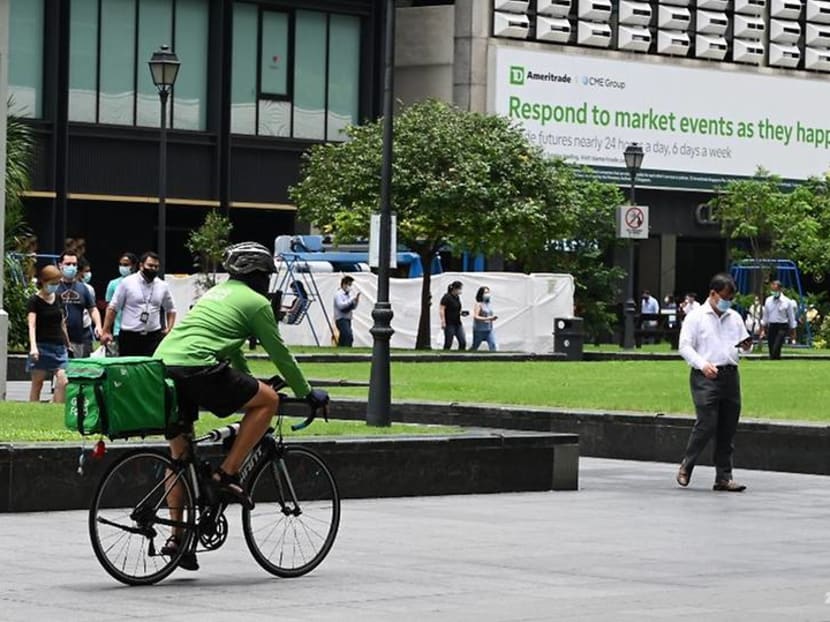
A Grab nutrient commitment homo rides along the pavement at Raffles Place in Singapore, Sep 15, 2020. (Photograph: AFP/Roslan Rahman)
12 May 2022 06:13AM (Updated: xiv May 2022 10:40AM)
SINGAPORE: Growing upward, my family did not have the habit of ordering in. It was not until my secondary school years in the 1990s that a catchy Pizza Hut jingle alerted me to the existence of food delivery.
Fast forwards to the early 2000s, university mates introduced new mainstays of any social gathering or late-night mugging session: Pizza and fast food you could order through a tele-operator - you only needed to have the flyers handy.
However, if you wanted hawker fare or international cuisines sent to your residence, you even so had to manually search for F&B outlets that had their own delivery arm. Unfortunately, there weren't many.
The state of the food delivery mural remained equally such until the 2010s when the gig economy started to have off and brought us operators such as foodpanda, Deliveroo, GrabFood and UberEats.
READ: Commentary: Why Grab, Gojek, Tokopedia and Body of water are the new darlings of Usa markets
However, using these apps in their early on years was not as smoothen an experience equally it is today. For starters, you needed reservoirs of patience to put up with technical glitches.
You had to be content with the limited choice of vendors, and you might have to take less than stellar client service in relation to considerably steep service fees. Dorsum then, food delivery civilization was still more novelty than normality.
COVID-nineteen CHANGED THINGS
Since the circuit breaker in Apr 2020, the appetite for food delivery services has burgeoned. Major players have been incentivised to up their game to keep up with growing contest.
For example, according to a survey conducted past the National University of Singapore, there was a 73 per cent increment in delivered meals during the circuit breaker alone.
READ: Commentary: Here's what months of food deliveries and takeaways accept taught u.s.
Nutrient vendors likewise are increasingly joining these platforms to gain access to a customer base of operations that has largely gone digital.
These developments are a win-win for consumers like me who are now reaping the benefits of vastly improved app applied science, and the greater multifariousness of nutrient choices and price points.
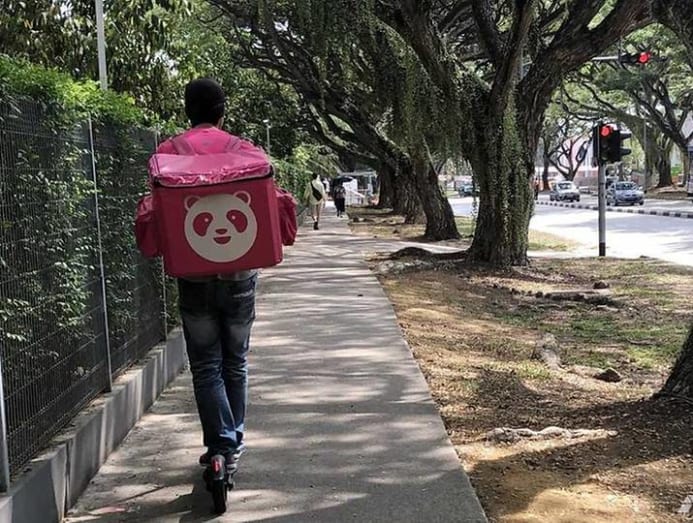
Come up to think of it, I went from being someone who ordered takeout several times a year to that person whose workdays are now marked past the arrival of the nutrient delivery guy at midday.
Like many of united states, due to the risks of the pandemic, I limited going out every bit much as before and and then concluded upwards ordering more than meals in.
The convenience of information technology soon grew on me and earlier I knew it, I was a regular on my food delivery app with my favourite list of food outlets memorised.
FOOD DELIVERY FEVER
But it wasn't just me. The infectiousness of this user-friendly consumption spread to the rest of the household too.
READ: Commentary: What is the logic of AirAsia entering Singapore's food delivery market?
On weekends, my children used to inquire, "Where are we going for lunch/dinner?". Now their question is, "What are nosotros ordering?" Instead of some microwaved popcorn and homemade guacamole to go on with the nacho dips, late nighttime snacking for my husband and me now involved popiah and barbecued ribs from our favourite eateries.
While I welcome the latest innovations in the food delivery space, it is hard non to find the opportunity costs of ordering in all the time.

The convenience of ordering nutrient in, and therefore non having to get ready to head out, has given rise to a wider inertia. Days and weeks tend to go past in a mistiness without the situational reference of having meals with family or colleagues at certain establishments.
Years from now, I cannot await at my photographic camera roll for a visual reminder well-nigh the roti prata breakfast I had with my sister at a famous stall in my neighbourhood, much less recall anything nosotros chatted about. Of course, that is completely my own doing.
MEMORIES OF DISPOSABLE CONTAINERS
Another example: Before the pandemic gave ascension to virtual worship services, my hubby and I would accept the kids out for a meal every Sunday after attention mass in church.
Fifty-fifty without referring to photos, I remember specific occasions based on the restaurants we ate at equally the multi-sensory retentiveness of those places remain etched in my listen: Observations about unique interior décor, the quirky waiter, people at a neighbouring table who talked too loudly, and so on.
READ: Commentary: The gig economy – a surprise boost from the pandemic and in Singapore, it'southward non going anywhere
The meals were also telling of different periods in our family life, reflecting how our tastes and preferences evolved over time. The lesser we dine out, the more than difficult it is to recognise the differences - equally we may find out in years to come as we pour through family albums and observe that much of last twelvemonth and 2022 were spent at home eating out of dispensable containers.

No matter how convenient or delicious a delivered repast they are usually amend enjoyed with Netflix. For many families similar mine, the focal signal of a living room gravitates towards what's on television and that includes mealtimes as well.
MISSING Family CONVERSATIONS
Moreover, with anybody doing their ain matter at home, it is hard to get them to sit downwardly and have a meal all at the same time.
Family bonding of a deeper kind thus would take to wait for that special occasion when we ate at actual restaurants, where there isn't a television set to distract and mobile devices are kept away.
When we are all seated around a tabular array at a eating house with piddling or no distractions, conversations will happen (even if they are forced).
READ: Commentary: Tougher action needed to become diners to return trays
READ: Commentary: Dining with safe distancing? Hither's how restaurants have adapted
Moreover, the comfort and convenience of food delivery services has not been forgiving on the waistline.
Certainly, the complacency of working in sweatpants and the ease of satisfying food cravings at the touch of a push button instead of having to walk to some place to eat can explain the staggering 5kg to 6kg my hubby and I have gained since the excursion breaker.
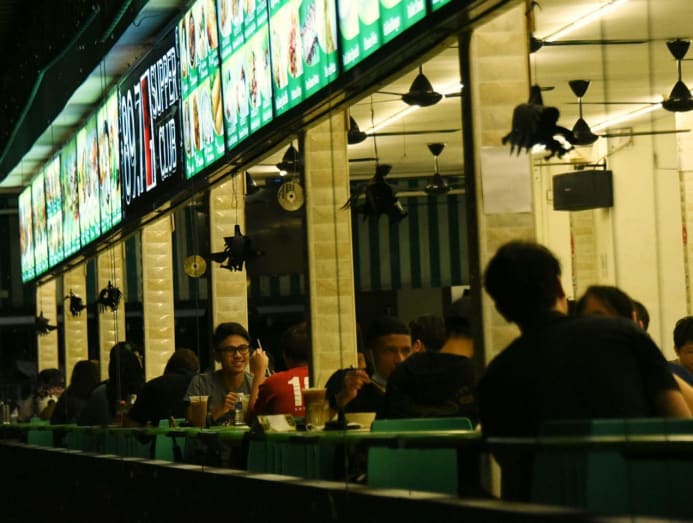
This sobering wake-up telephone call was what triggered our cutting down on delivered meals and starting a daily ritual of 2-hour-long forenoon walks, which - autonomously from being energising - turned out to exist educational as well.
Equally nosotros passed various nutrient centres and coffeeshops, nosotros were able to put a confront to the many individual vendors from the food delivery apps. These apps have helped such stalls, many of which are non-descript, accomplish out to customers like me. Otherwise, we might not have come to know of their delicious offerings.
Striking THE RIGHT BALANCE
On the one manus engineering science has helped such small business concern owners explore new income streams. On the other manus, learning who they were and their stories through our walks meant that they were more than just digital integers we clicked on so effortlessly.
READ: Commentary: Maybe private-hire drivers and food delivery riders don't desire full-fourth dimension jobs
Perhaps that is the kind of balance we demand in our lives whenever new innovations or technology emerge to make our lives easier – to not permit information technology dictate our lifestyles, but to incorporate it to improve the lives of others and our ain. That approach is key when it comes to making food ordering decisions every bit well.
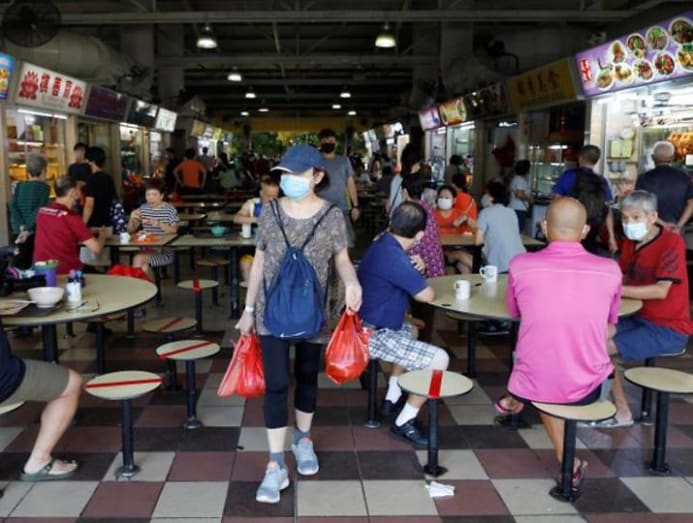
If there's anything that my once over-reliance on food commitment has taught me, information technology'southward not to prize convenience and comfort above all else.
Instead, making space for occasions to have the family to restaurants, to put actual faces to my favourite in-app hawkers, and to generally eat in the company of people instead of devices can be immensely rewarding.
Nutrient delivery apps are here to stay and so we ameliorate learn how to live with them and not through them.
Rachel Tey is an author and editorial consultant based in Singapore.

Recent Searches
Trending Topics
Source: https://cnalifestyle.channelnewsasia.com/commentary/commentary-food-delivery-apps-are-meant-make-our-lives-easier-not-worse-295021
0 Response to "Commentary: Food delivery apps are meant to make our lives easier, not worse"
Postar um comentário